Choose which tools Pi can use for a session, by default, or with a specific model.
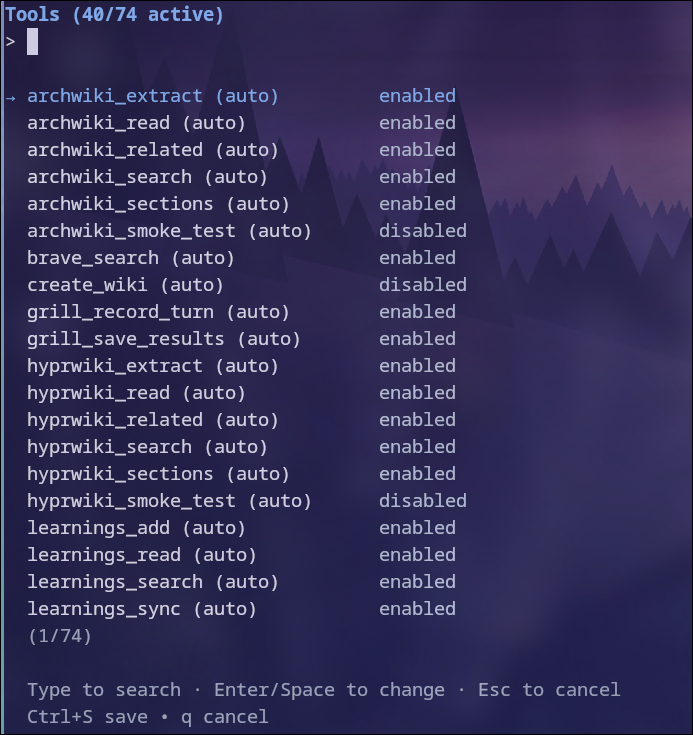
- Lists available tools, searches names first, and sorts by status or discovery keywords.
- Saves a selection for the current session branch.
- Sets a global default or an exact provider/model profile.
- Applies model profiles when the active model changes.
- Keeps WebUI and TUI resource choices in sync.
pi install npm:@firstpick/pi-extension-toolsRestart Pi if the package does not appear in your current session.
Run /tools, then choose where the selection applies:
- Session only changes the current session branch.
- Global default applies when no session or model selection overrides it.
- Model default applies to one exact provider/model pair.
The resource list has separate Name, Discovery, and Status columns. Discovery shows how Pi found the tool, such as auto, while Status shows enabled or disabled. The selected tool's description appears below the list. Type to fuzzy-search by name, discovery value, or description. Name matches appear first, then source matches, then description matches. Use the arrow keys to move, press Enter to toggle, Ctrl+X to disable all matching tools, Ctrl+A to enable all matching tools, and Ctrl+S to save. Escape returns to the previous setup screen. From the scope screen it closes the setup flow. Ctrl+C closes the entire setup flow immediately.
To keep all tools visible but move a group to the top, enter enabled, disabled, auto, or Pi built-in as the whole search. The first two sort by Status; the others sort by Discovery. In these sort-only modes, Ctrl+A and Ctrl+X affect all tools, not just the group at the top.
This extension is the sole owner of the TUI /tools command. WebUI presents the same saved scopes in its browser interface without registering another command.
See TECHNICAL.md for scope precedence, storage, compatibility, and troubleshooting information.