

|
When i read the example of cross_section (https://unidata.github.io/MetPy/latest/examples/cross_section.html#sphx-glr-examples-cross-section-py), i found that this example used the function mpcalc.cross_section_components to obtain components of the vector field in the tangential and normal directions. |
Replies: 1 comment 1 reply

|
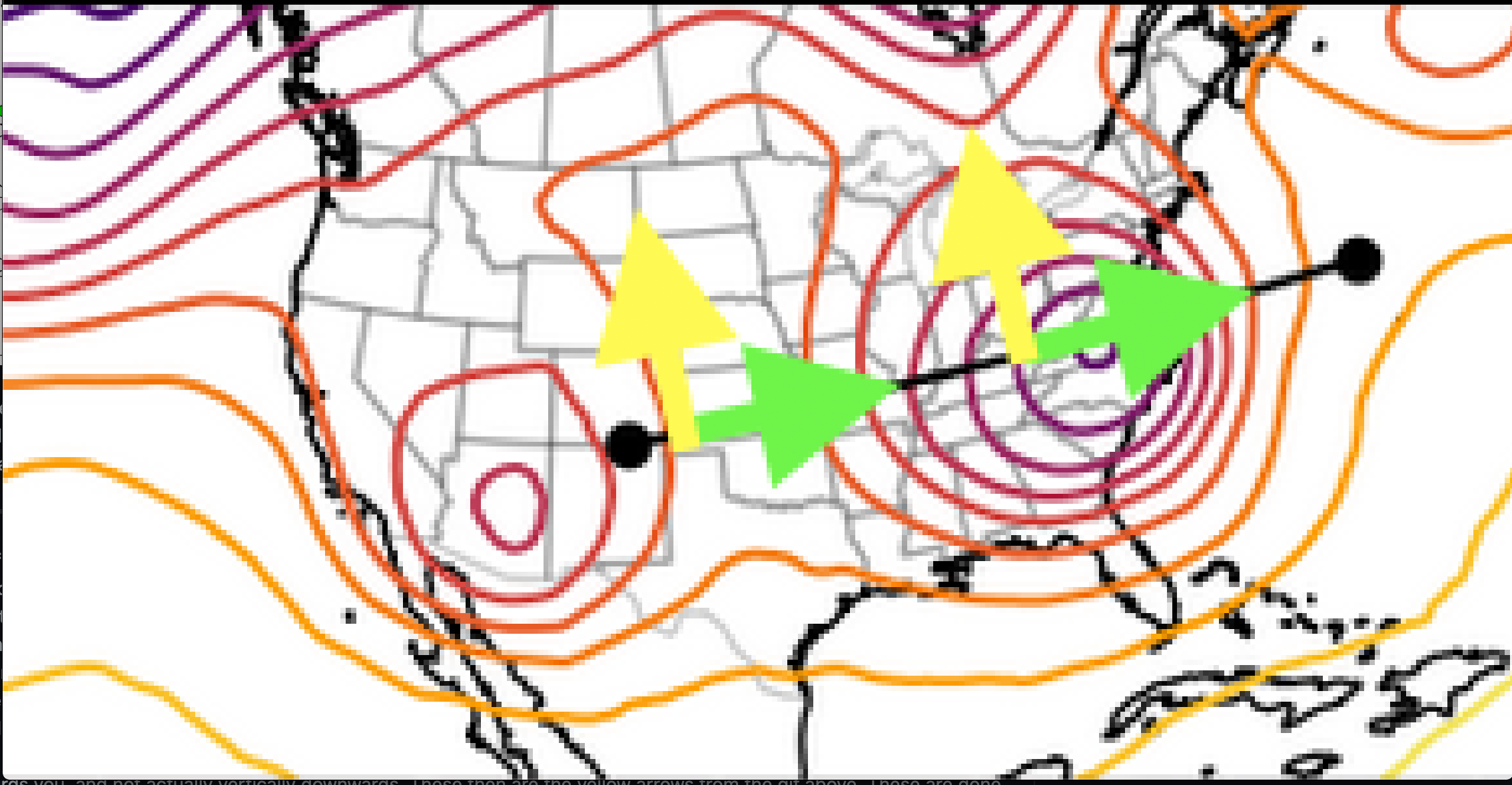
I think there's two places to clarify things here, hopefully! First: What is In this gif, the green arrow is the tangential component of the vector as we move along this line, and the yellow arrow is the normal vector. We are calculating the green and yellow arrows for our winds at every point along our cross section. This is done at every vertical level, separately.
Second: the confusing limitations of 2-d visualizations of 3-d problems. So here, what the barbs actually represent: try to picture the actual line of our cross-section as running along the bottom of our graphic, extending upwards vertically into the atmosphere. Then I could represent the previously-described tangential component of the winds by the left-right component of the barbs, following along this cross-section line. Barbs pointing to the right have winds totally parallel to the line of our cross section you can see on the map inset, and left-pointing barbs are totally anti-parallel. These are the green arrow from the gif above. That then leaves that the up-down component of these barbs represents the normal component of the winds, and not their vertical component. So a barb pointing upward represents a wind totally blowing perpendicular ("to the left") of our cross-section line, or is basically pointing "into the page" and not actually vertically upwards. Similarly, a barb pointing downwards is perpendicular "to the right" of the cross-section, or is blowing "out of the page" towards you, and not actually vertically downwards. These then are the yellow arrows from the gif above. I hope this helps, if even just somewhat! If not, don't hesitate to follow up. Thanks! |


|
I got it. So if i want to get the real circulation on the cross section, i just need to substitute normal component to the vertical component when i plot using function barbs. Thank you for your patience! |


I think there's two places to clarify things here, hopefully!
First: What is
cross_section componentscalculating? Here it is taking a look at the wind vectors we give it, with some x- and y-components, and instead describing that same wind in terms of the vectors tangential to our line of cross section, and the vector normal to that tangential vector (i.e. perpendicular to the tangential component via the right-hand-rule, similar to how x- and y-components of a vector are related to each other.)In this gif, the green arrow is the tangential component of the vector as we move along this line, and the yellow arrow is the normal vector. We are calculating the green and yellow arrows for …