


Crowd Light Show turns a crowd's phones into one synchronized, music-reactive light show. The audience scans a QR code — no app to install — and every phone's screen (and the Android camera flash) flashes together, driven live from a browser console. It's epilepsy-safe by design (hard-capped ≤ 3 flashes/s, no red strobe), gives you VJ-grade live control, and you can self-host it. Free and open source.
Wristbands cost $5–10 a head. Your crowd already has the hardware.
▶ Try it now: lightshow.flyreelstudio.eu/try — open the demo, scan the QR with your phone, and watch your own screen join the show.

🎥 See it in action (6 min): Watch on GitHub · Watch on YouTube (mirror)
🐱 Coming next — Cat Conga: when the show ends, the crowd falls into a shared 3D (Gaussian-Splatting) world as cats forming one giant conga chain, then finds each other in the real crowd. Design docs (planned, not built yet).
git clone https://github.com/AndriiShramko/crowd-light-show
cd crowd-light-show
npm install
OPERATOR_PASS=changeme npm start
# open http://localhost:3000/studio  → press Start → scan the QR on your phone → it flashes
Requires Node.js 20+ and ffmpeg on the host. Prefer Docker? docker build -t lightshow . && docker run -p 3000:3000 -e OPERATOR_PASS=changeme -e PUBLIC_BASE_URL=http://localhost:3000 lightshow. (The camera flash / torch needs a secure context — localhost or HTTPS.)
The show
- One crowd, one light show — every phone flashes together, in time with the music, off an NTP-like WebSocket clock. Scales to a stadium; the timeline runs locally on each phone so it survives congested venue networks and reconnects automatically.
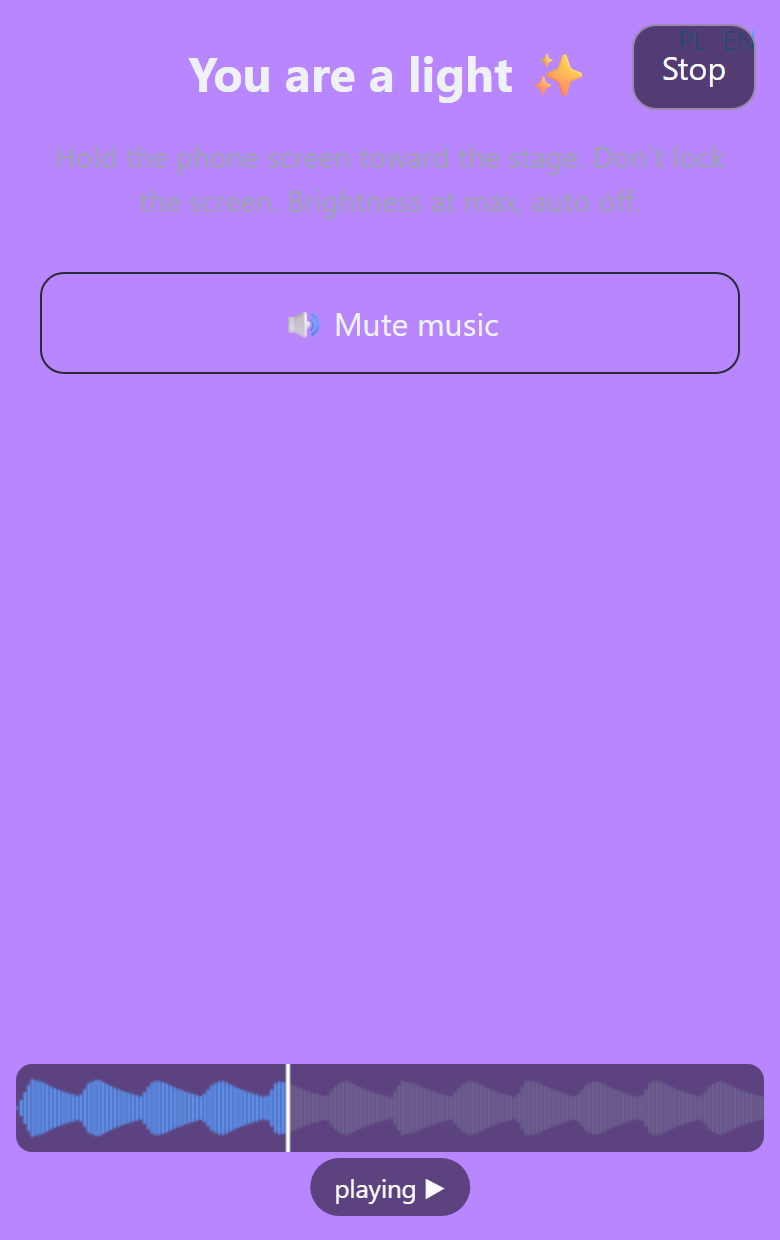
- No app, no wristbands — the audience scans a QR and joins in the browser. Screen light on every phone (iOS + Android); the real LED flash also fires on Android.
- Music-reactive — upload a track; every phone plays it in sync and the lights follow the music (auto-gain so quiet and loud both look good).
- Or no upload at all — use the room's own music. Switch the source to your device's microphone and the crowd reacts live to whatever is playing: a DJ, a band, the house PA. The audio never leaves your device — only a loudness number, ~20×/s.
- Every phone shares the show — each screen carries that room's join QR, so anyone standing nearby can scan it off the glass and join the same show.
The control room (screenshots)
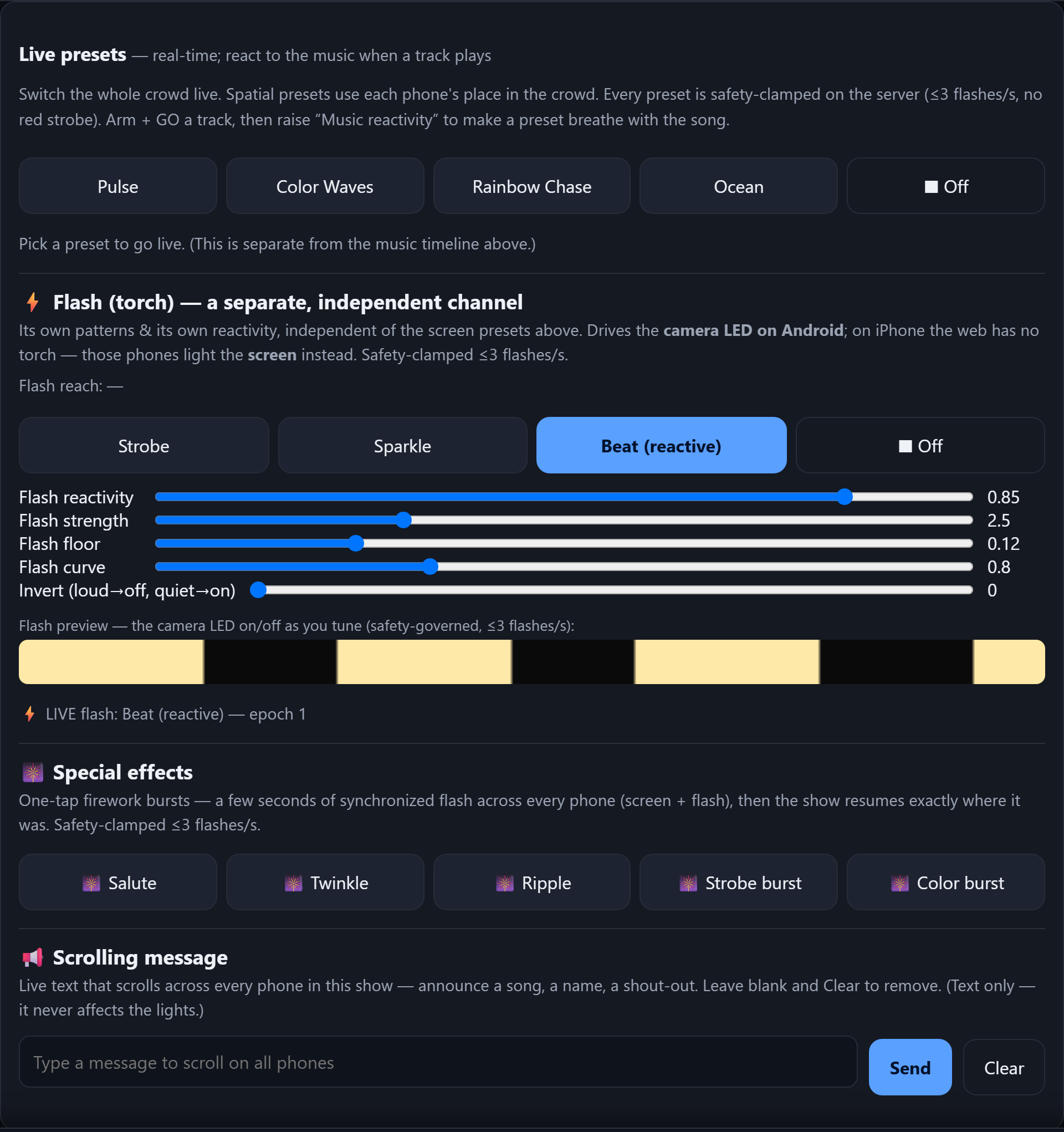
- Live presets — Pulse · Colour Waves · Rainbow Chase · Ocean, plus a spatial wave that reads across the crowd. A separate flash (torch) channel with its own patterns.
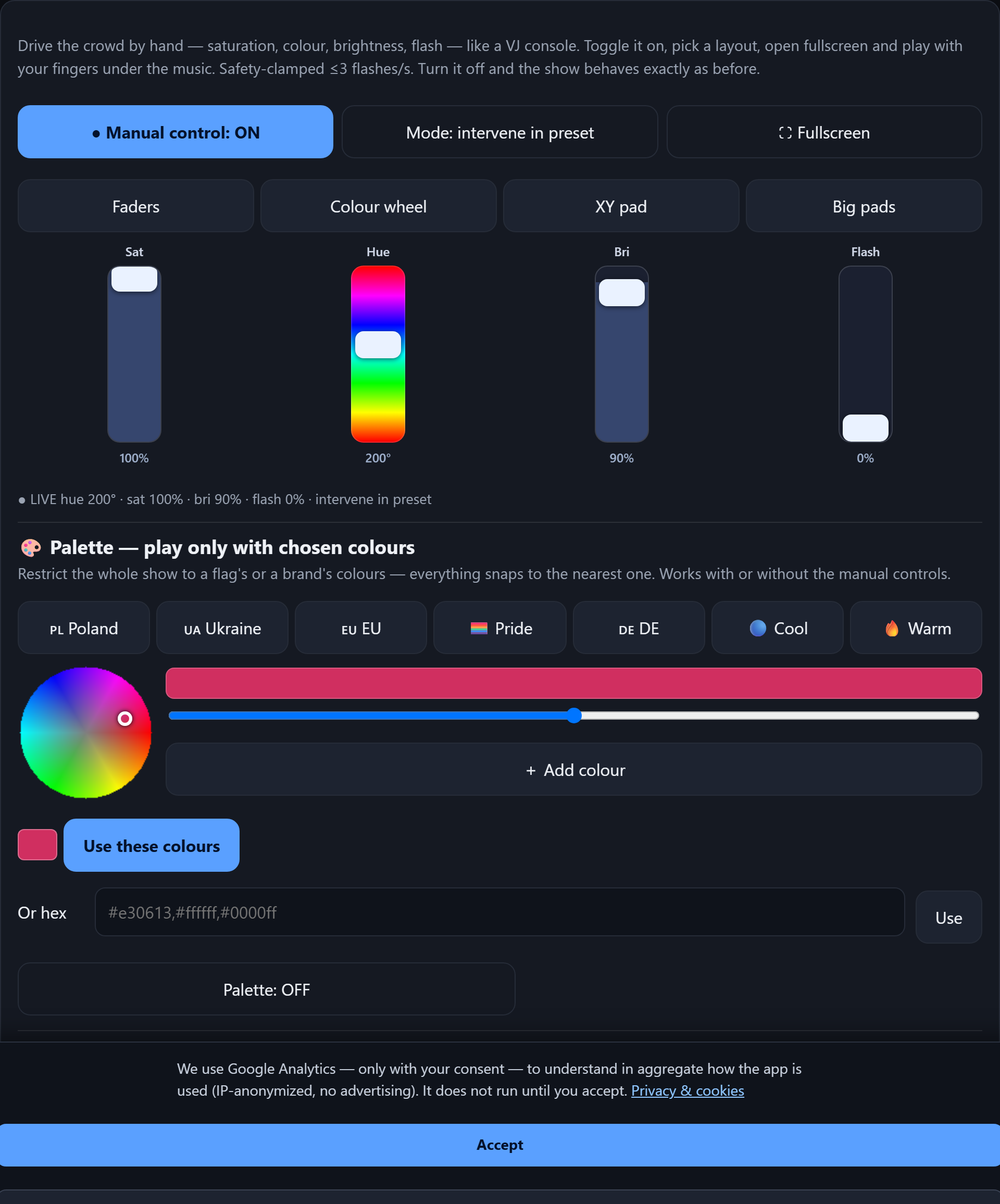
- The VJ pult — drive the crowd by hand: saturation, colour, brightness, flash, in four touch layouts (faders / colour wheel / XY pad / big momentary pads), fullscreen, "intervene in a preset" or "manual only".
- Palette lock — restrict the whole show to a flag's or a brand's colours (pick on the wheel, or one-tap a flag).
- Big moments — one-tap synchronized fireworks, a scrolling marquee on every phone, global mute, seek, and BLACKOUT (which keeps the music playing).
For pros
- Drive it from Resolume / TouchOSC / Bitfocus Companion over OSC, or map a USB fader/pad box with WebMIDI. See the VJ & OSC guide and
tools/vj-bridge/.
Safe & private
- Epilepsy-safe governor enforced on every phone AND the server: ≤ 3 flashes/s, no large saturated-red strobe, ≥ 150 ms brightness ramps (WCAG 2.3.1 / 2.3.2 — below UK HSE strobe guidance). Photosensitivity warning + consent gate + always-visible Stop.
- Anonymous & ephemeral — no accounts, no personal data; audience phones join and leave.
Runs as a single container (Node.js + ffmpeg). Apache-2.0 — self-host with no limits.
docker build -t lightshow .
docker run -p 3000:3000 \
  -e OPERATOR_PASS=changeme \
  -e PUBLIC_BASE_URL=https://your-host \
  -e STUDIO_ENABLED=1 \
lightshow| Env var | Purpose |
|---|---|
OPERATOR_PASS |
Password for the main operator console (/operator). |
PUBLIC_BASE_URL |
Public base URL baked into the join QR (e.g. https://your-host). |
STUDIO_ENABLED |
1 (default) enables the no-login guest console at /studio. |
PUBLIC_UPLOAD_ENABLED |
1 lets guests upload their own music (off by default). |
The included docker-compose.yml is a production example wired for an nginx-proxy + Let's Encrypt TLS stack (it reads secrets from a config.env — copy config.env.example). For a plain local run, use the docker run above or the npm start path. The flashlight/torch needs a secure context (HTTPS in production); put it behind a reverse proxy that terminates TLS and forwards WebSockets. Pages: / landing · /studio guest console · /operator main console · /join audience · /vj integration guide.
The existing token-scoped /api/console/* + WebSocket surface is the external-control API. A tiny zero-dependency bridge (tools/vj-bridge/) runs on the VJ's own laptop, listens for OSC over UDP, and forwards it to the show over HTTPS — so nothing new is opened on the show server.
node tools/vj-bridge/bridge.mjs --api https://your-host --token "$CLS_CONSOLE_TOKEN" --osc-port 9000OSC address map (/cls/manual/hue, /cls/preset, /cls/fx, /cls/palette, /cls/blackout, …), Resolume / TouchOSC / Companion setup, and the WebMIDI mapping are in the VJ & OSC guide and tools/vj-bridge/README.md. Every command is re-validated + re-governed server-side, so external control can't exceed the safety limits or drive another room.
- The console is the source. Upload audio; the server analyses it and builds a light timeline (a cue list) that passes the safety governor.
- Clock sync. On join, each phone runs an NTP-like offset handshake over WebSocket so every device agrees on one show time.
- Local playback. The full timeline is sent once, on join; each phone renders the show locally off its synced clock — so the crowd stays in step on bad Wi-Fi and finishes the show even if its connection drops. Live presets / manual / palette are tiny broadcasts each phone renders locally.
- Screen + torch. The screen is the cross-platform light (iOS + Android); on Android the LED flash fires too (camera permission). iOS can't drive the flashlight from the web, so the screen is the light there.
Node.js + Fastify, ws (WebSocket), better-sqlite3, qrcode, ffmpeg; vanilla-JS clients (no framework, no build step). Ships as one Docker container. Parity- and safety-tested (npm run test:safety, node test/sync_harness.mjs, and the test/ suite).
Flashing light can trigger seizures. A safety governor is the last, unchangeable stage on every phone and on the server: it hard-caps flashing to ≤ 3 flashes/second, blocks large saturated-red strobing (WCAG 2.3.1 / 2.3.2), and ramps big brightness changes over ≥ 150 ms. The audience sees a photosensitivity warning + consent gate and an always-visible Stop. A show cannot be configured — or externally driven — past these limits.
Anonymous and ephemeral: no accounts, no personal data, no tracking cookies (the hosted site uses consent-gated, IP-anonymised analytics only). Audience phones join a live show and leave.
The microphone source runs only on the operator's own device, and only while they turn it on: the sound is analysed locally and the sole thing sent is a single loudness value between 0 and 1, about 20 times a second. No audio is recorded, stored or uploaded, and audience phones are never asked for microphone access.
- ✅ Everyone flashes together, music-reactive, live presets, VJ pult, palette lock, effects, OSC/MIDI integration.
- Next: zones & richer spatial patterns; per-seat mapping → "draw with light" across a stadium (research-grade).
Licensed under the Apache License 2.0 — see LICENSE and NOTICE. Contributions welcome (CONTRIBUTING.md, Code of Conduct).
Andrii Shramko — LinkedIn
Free for any use. Prefer not to self-host, or want it customized / operated for your event? A hosted, done-for-you service is available — pricing · email zmei116@gmail.com · book a call.
Music note: clearing public-performance rights (e.g. ZAiKS in Poland) is the organizer's responsibility; the app provides the lighting, not the music licence.