

Medical trainee and clinical researcher building auditable tools at the intersection of medicine, evidence synthesis, and AI.
Explore ClinEval Lab | Work with me | Explore TrialMirror
ClinEval Lab is an Ollama-first evaluation workbench for clinical information tasks. It tests structured extraction, answer-versus-abstain behavior, sentence-level evidence support, unsupported claims, and confidence calibration while retaining every raw response and reproducibility hash.
The first release includes 12 wholly synthetic matched-pair cases across melanoma pathology, transplant evidence abstraction, and randomized-trial evidence extraction. Its local Qwen demonstration produced 75.0% decision accuracy but only 33.3% strict case success after field and evidence checks. These are proof-of-execution results, not clinical validation.
I offer a fixed-scope Clinical LLM Evaluation Sprint for early health-AI teams and research groups that need an inspectable test set and failure report for one text workflow.
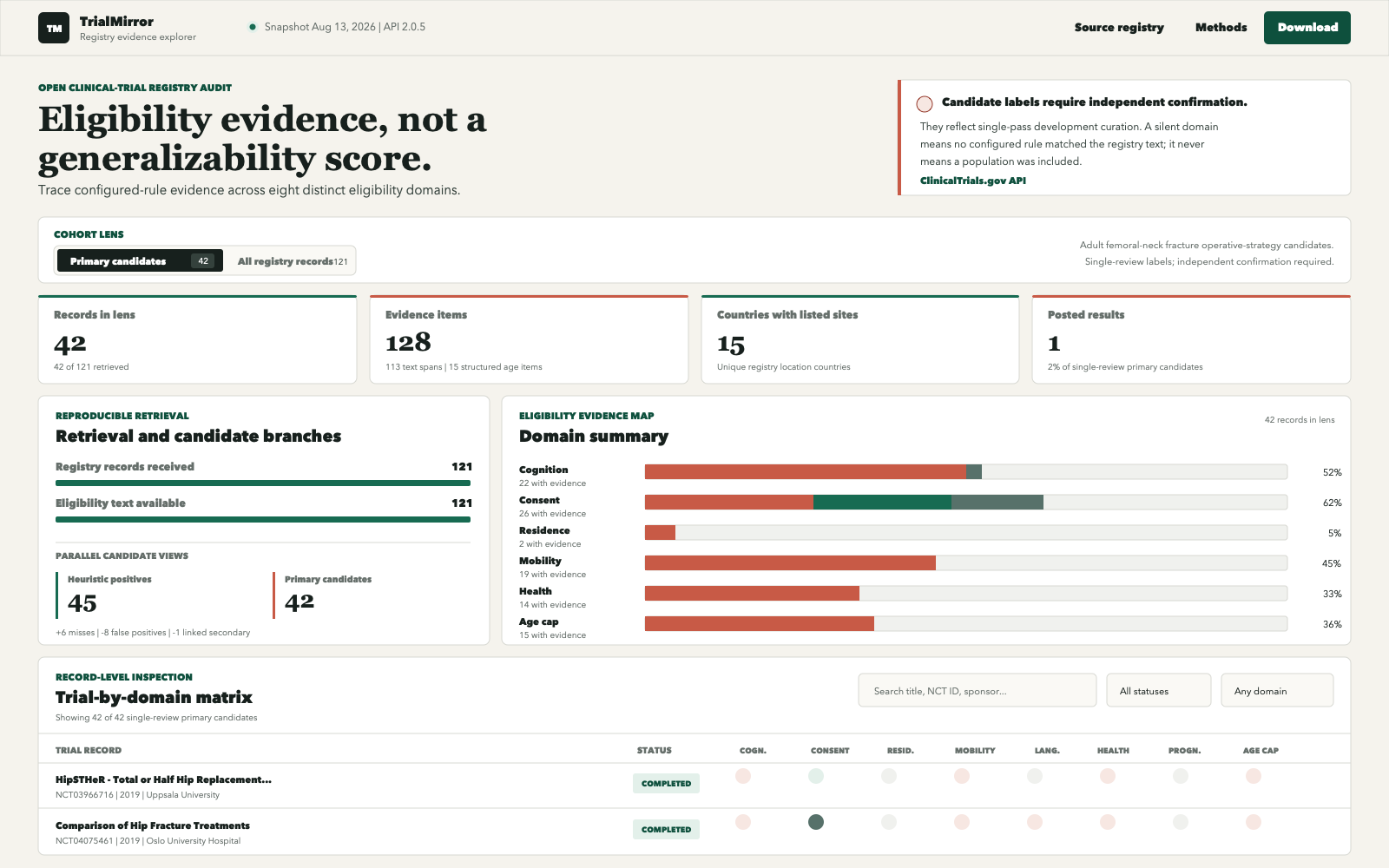
TrialMirror is a source-linked explorer for auditing what clinical-trial eligibility criteria say about populations often underrepresented in research. The first public release examines randomized femoral-neck-fracture registry records from ClinicalTrials.gov.
- Every text signal opens the exact registry wording and source offsets.
- Cognition, consent, residence, mobility, language, health, prognosis, and age remain distinct instead of becoming a misleading score.
- Silent means no configured rule match, never evidence of inclusion.
- The frozen public snapshot, ontology, curated candidate roles, hashes, exports, tests, CI, and live dashboard ship together.
The release is deliberately explicit about its limits: candidate roles are not adjudicated systematic-review inclusions, and registry criteria do not establish who was enrolled.
- Clinical-trial applicability and representation
- Reproducible medical-AI evaluation
- Clinical evidence synthesis with inspectable provenance
- Longitudinal risk modeling and digital-twin methods in transplantation
I am interested in tools that help a clinician or researcher inspect the evidence, challenge the assumptions, and reproduce the result. AI is most useful to me when it makes that process more transparent, not when it hides uncertainty behind a score.
The MedGemma melanoma pathology pilot is a reproducibility-first evaluation scaffold. Its repository documents the current access and compute gate rather than presenting incomplete inference as a finished benchmark.