




Python API client for submarine cable data. Look up undersea fiber optic cable systems, explore landing station locations, query cable operators and owners, and retrieve route geometries — all from CableFYI, a submarine cable reference platform mapping the physical infrastructure of the global internet.
Over 95% of intercontinental data traffic travels through submarine cables laid on the ocean floor. CableFYI catalogs active and planned cable systems with their landing points, Ready-for-Service (RFS) dates, cable lengths, fiber pair counts, and design capacities — used by network engineers, telecom analysts, and infrastructure researchers.
Explore submarine cables at cablefyi.com — browse the cable map, search landing stations, and view operator data.
- Install
- Quick Start
- What You Can Do
- Command-Line Interface
- MCP Server (Claude, Cursor, Windsurf)
- REST API Client
- API Reference
- Learn More About Submarine Cables
- Also Available
- Network FYI Family
- License
pip install cablefyi                # Core (zero deps)
pip install "cablefyi[cli]"         # + Command-line interface
pip install "cablefyi[mcp]"         # + MCP server for AI assistants
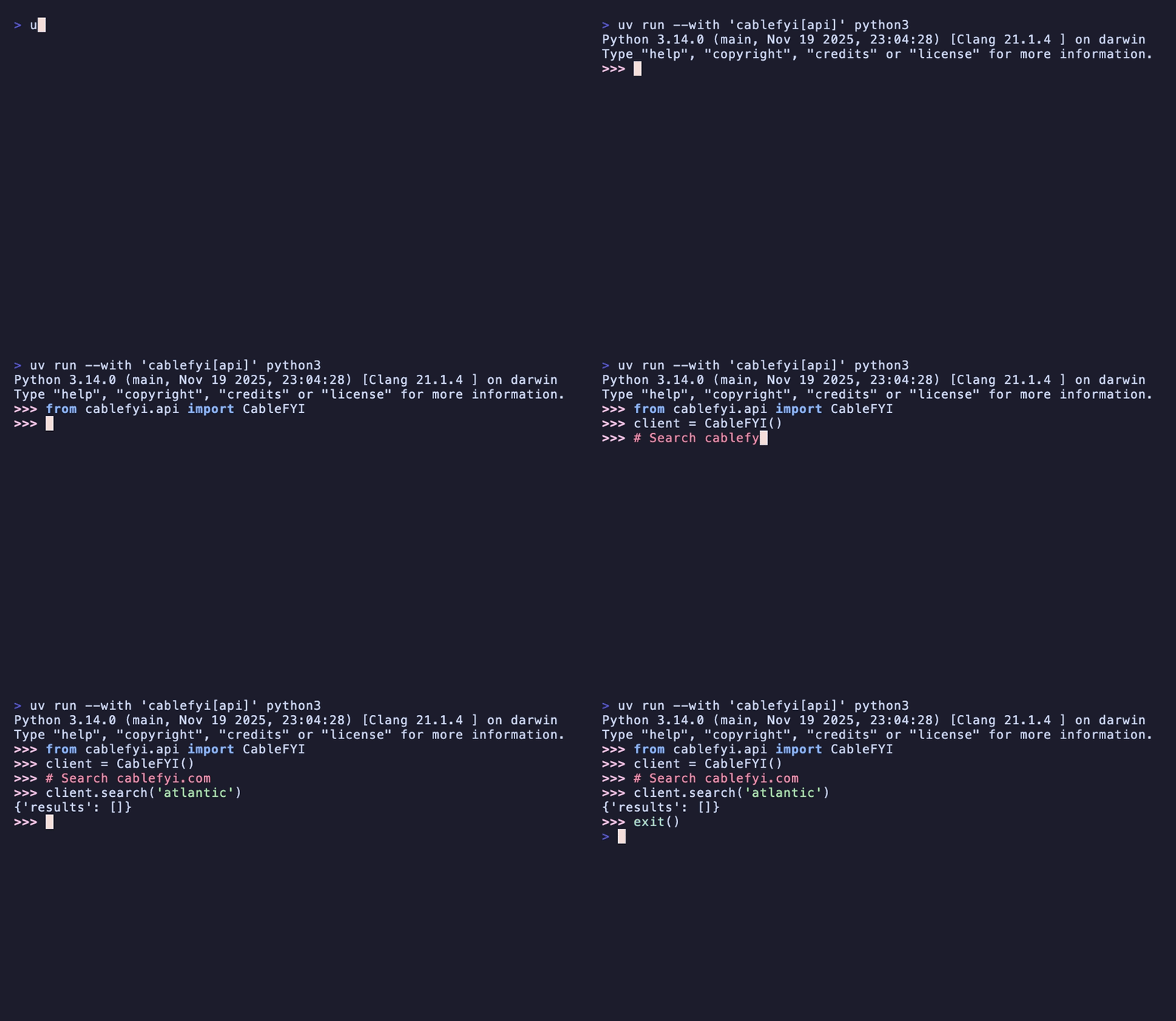
pip install "cablefyi[api]"         # + HTTP client for cablefyi.com API
pip install "cablefyi[all]" # Everythingfrom cablefyi.api import CableFYI
with CableFYI() as api:
# Look up a submarine cable system
cable = api.get_cable("marea")
print(cable["name"]) # MAREA
print(cable["length_km"]) # 6,605 km
print(cable["rfs_year"]) # 2018
print(cable["owners"]) # Microsoft, Meta, Telxius
# List cables by country
cables = api.list_cables(country="united-states")
for c in cables:
print(f"{c['name']}: {c['length_km']} km")
# Search cable infrastructure
results = api.search("transatlantic")Submarine telecommunications cables are the backbone of the global internet. Each cable system consists of fiber optic strands encased in protective layers (polyethylene, steel wire, copper) laid on the ocean floor. Modern cables contain multiple fiber pairs, each carrying terabits per second using wavelength-division multiplexing (WDM).
| Era | Capacity per Fiber Pair | Example Cable |
|---|---|---|
| 2000s | 640 Gbps | FLAG Atlantic-1 |
| 2010s | 10-20 Tbps | AEConnect, Hibernia Express |
| 2018+ | 20-80 Tbps | MAREA (224 Tbps total), Dunant |
| 2024+ | 100+ Tbps | Firmina, Echo/Bifrost |
from cablefyi.api import CableFYI

with CableFYI() as api:
    # Get full cable system details
    cable = api.get_cable("dunant")
    print(f"Name: {cable['name']}")
    print(f"Length: {cable['length_km']} km")
    print(f"Fiber pairs: {cable.get('fiber_pairs')}")
    print(f"RFS: {cable.get('rfs_year')}")
    print(f"Owners: {cable.get('owners')}")
Learn more: Cable Directory · Glossary
Landing stations are the shore-based facilities where submarine cables come ashore and connect to terrestrial networks. Major landing hubs include Bude (UK), Marseille (France), Tuas (Singapore), and Virginia Beach (US) — each serving as a critical junction for dozens of cable systems.
from cablefyi.api import CableFYI

with CableFYI() as api:
    # List landing stations by country
    stations = api.list_landing_stations(country="united-kingdom")
    for s in stations:
        print(f"{s['name']}: {s.get('cable_count', 0)} cables")

    # Get landing station details
    station = api.get_landing_station("bude")
    for cable in station.get("cables", []):
        print(f"  {cable['name']}")
Learn more: Landing Stations · Guides
Submarine cable ownership has shifted from telecom consortia to hyperscale cloud providers. Google, Meta, Microsoft, and Amazon now own or co-own major cable systems, investing billions to control their network paths and reduce latency for cloud services.
| Owner Type | Examples | Strategy |
|---|---|---|
| Hyperscalers | Google, Meta, Microsoft, Amazon | Private capacity, low-latency cloud |
| Carrier-neutral | SubCom, NEC, Alcatel (builders) | Build and maintain cables |
| Telecom consortia | Traditional multi-carrier ownership | Shared capacity, legacy model |
| Regional operators | Telxius, Aqua Comms | Specific corridor focus |
from cablefyi.api import CableFYI

with CableFYI() as api:
    # List cable operators/owners
    operators = api.list_operators()
    for op in operators[:5]:
        print(f"{op['name']}: {op.get('cable_count', 0)} cables")
Learn more: Cable Operators · Glossary
Modern submarine cables use optical fiber to transmit data as pulses of light. Key technologies include WDM (wavelength-division multiplexing) to carry multiple signals on different light wavelengths, EDFA (erbium-doped fiber amplifiers) to boost signals every 60-80 km, and coherent detection for high spectral efficiency.
| Technology | Function | Impact |
|---|---|---|
| WDM | Multiple wavelengths per fiber | Multiplied capacity |
| EDFA | Optical signal amplification | 60-80 km repeater spacing |
| Coherent detection | Phase + amplitude modulation | Higher bits/symbol |
| SDM (Space-division) | Multiple fiber cores | Next-gen capacity |
from cablefyi.api import CableFYI

with CableFYI() as api:
    # Search for cables by technology or route
    results = api.search("pacific")
    for r in results:
        print(f"{r['name']}: {r.get('length_km', 'N/A')} km")
Learn more: Cable Technology · API Documentation
pip install "cablefyi[cli]"

cablefyi cable marea                         # Cable system details
cablefyi search "atlantic"                   # Search cables
cablefyi country united-states               # Cables landing in US
cablefyi landing-stations united-kingdom # UK landing stationspip install "cablefyi[mcp]"{
"mcpServers": {
"cablefyi": {
"command": "uvx",
"args": ["--from", "cablefyi[mcp]", "python", "-m", "cablefyi.mcp_server"]
}
}
}from cablefyi.api import CableFYI
with CableFYI() as api:
cable = api.get_cable("marea") # GET /api/v1/cables/marea/
cables = api.list_cables(country="united-states") # GET /api/v1/cables/?country=united-states
stations = api.list_landing_stations(country="uk") # GET /api/v1/landing-stations/?country=uk
results = api.search("google") # GET /api/v1/search/?q=googlecurl -s "https://cablefyi.com/api/v1/cables/marea/"{
"slug": "marea",
"name": "MAREA",
"length_km": 6605,
"rfs_year": 2018,
"owners": ["Microsoft", "Meta", "Telxius"]
}Full API documentation at cablefyi.com/developers/.
| Function | Description |
|---|---|
api.get_cable(slug) |
Cable system details (length, capacity, owners) |
api.list_cables(country) |
List cables, optionally by country |
api.list_landing_stations(country) |
Landing stations by country |
api.get_landing_station(slug) |
Station details with connected cables |
api.list_operators() |
All cable operators/owners |
api.search(query) |
Search cables, stations, and operators |
- Browse: Cable Directory · Landing Stations · Operators
- Guides: Cable Guides · Glossary
- API: REST API Docs · OpenAPI Spec
| Platform | Install | Link |
|---|---|---|
| npm | npm install cablefyi |
npm |
| MCP | uvx --from "cablefyi[mcp]" python -m cablefyi.mcp_server |
Config |
Part of the FYIPedia open-source developer tools ecosystem — internet infrastructure, cables, domains, and protocols.
| Package | PyPI | npm | Description |
|---|---|---|---|
| cablefyi | PyPI | npm | Submarine cables, landing points, operators — cablefyi.com |
| tldfyi | PyPI | npm | TLD registry, domain extensions, WHOIS — tldfyi.com |
| ipfyi | PyPI | npm | IP geolocation, ASN lookup, CIDR ranges — ipfyi.com |
| protocolcodes | PyPI | npm | HTTP status codes, protocol references — statuscodefyi.com |
Embed CableFYI widgets on any website with cablefyi-embed:
<script src="https://cdn.jsdelivr.net/npm/cablefyi-embed@1/dist/embed.min.js"></script>
<div data-cablefyi="entity" data-slug="example"></div>
Zero dependencies · Shadow DOM · 4 themes (light/dark/sepia/auto) · Widget docs
MIT