A practical, compassionate guide to vegan alternatives, animal-derived ingredients, everyday animal use, plant-based recipes, and making the transition one step at a time.
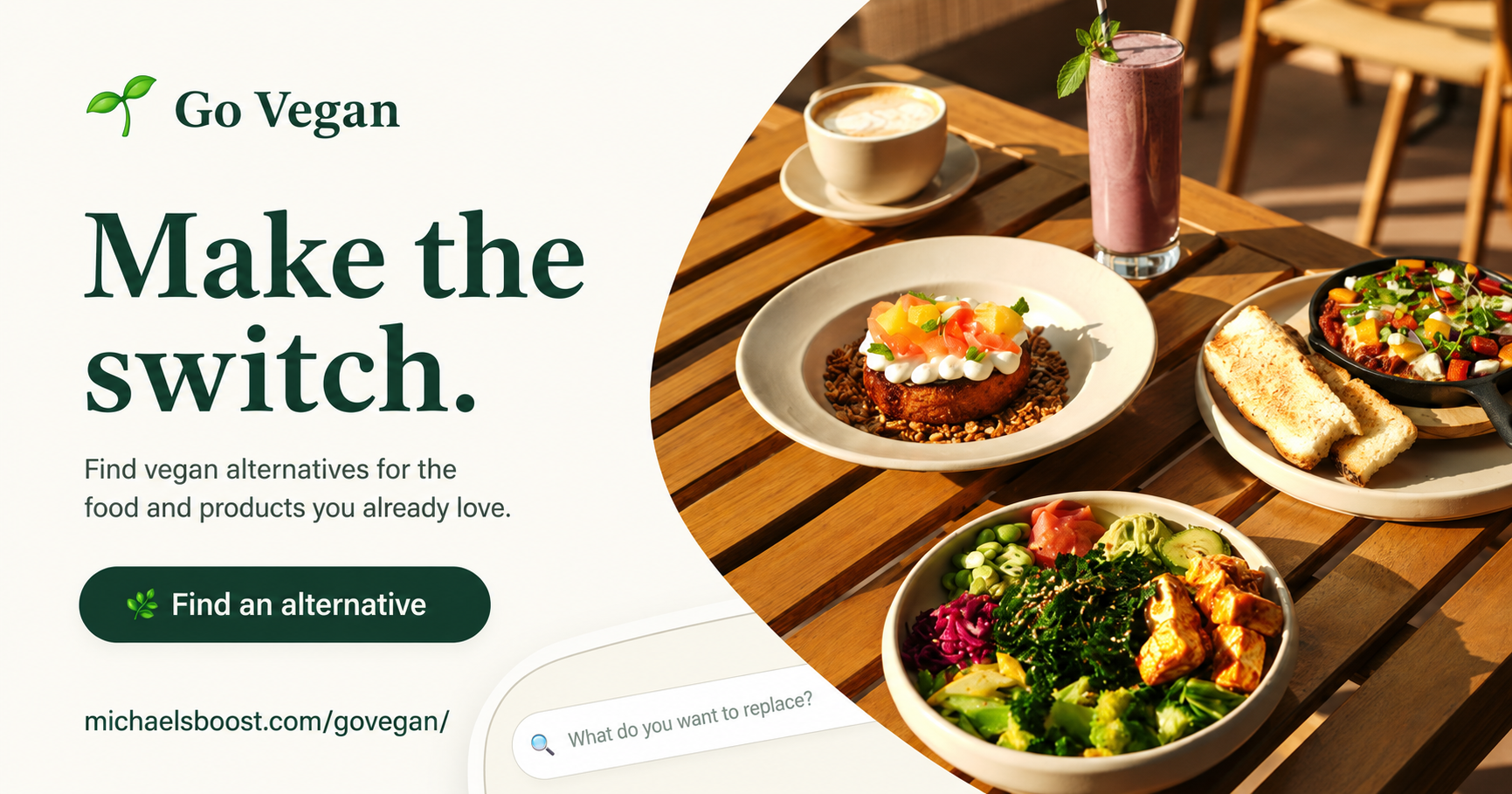


Go Vegan is a free, open-source educational app for people who want to reduce or eliminate their use of animal products but do not know where to begin.
Animal-derived products can appear in food, clothing, cosmetics, household supplies, supplements, medicine, furniture, vehicles, art materials, and many other parts of everyday life. Go Vegan brings that information together in one approachable place.
The app helps users:
- find vegan replacements for familiar foods and products
- compare commercial, homemade, and whole-food alternatives
- identify animal-derived or source-dependent ingredients
- learn which animals are used by different industries
- understand common welfare and exploitation concerns
- discover affordable plant-based recipes
- learn basic vegan nutrition considerations
- follow a gradual transition plan
- save useful products and resources
Go Vegan is designed around informed, compassionate action. It does not demand perfection or assume everyone begins with the same health, income, access, knowledge, or living situation.
Imagine you want to replace milk, eggs, leather, gelatin, wool, fish, honey, or another animal-derived product.
Normally, you may need to search several different websites to answer questions such as:
- What vegan alternatives exist?
- Can I buy them locally or make them myself?
- Is this unfamiliar ingredient animal-derived?
- Which animal does it come from?
- What everyday products may contain it?
- Why is the original product considered an animal-welfare concern?
- What nutritional role did the food serve?
- What can replace that role?
Go Vegan is intended to connect those questions.
It is not simply a list of vegan brands. It connects products, recipes, ingredients, animals, industries, alternatives, and educational resources so users can understand both what to replace and why.
The Animals Library introduces animals used for food, clothing, materials, research, entertainment, labor, cosmetics, household goods, and industrial purposes.
Animal profiles may include:
- natural habitat and diet
- social behavior and communication
- cognition and parenting
- natural behaviors
- potential lifespan
- industries in which the animal is used
- products and ingredients derived from the animal
- documented welfare concerns
- practical vegan alternatives
- supporting sources
Some entries represent broad groups, such as fish or mollusks. These profiles are clearly identified because behavior, biology, and lifespan can vary substantially between species.
Sensitive subjects are presented factually and without unnecessary graphic detail.
The Ingredient Checker lets users paste an ingredient list and scan it for known animal-derived or source-dependent terms.
Results distinguish between:
| Status | Meaning |
|---|---|
| Animal-derived | The ingredient ordinarily comes from an animal source |
| Usually animal-derived | Animal sourcing is common, although alternatives may exist |
| May be animal-derived | The source can be animal, plant, microbial, or synthetic |
| Usually plant or microbial | Commonly vegan, but unusual sources may require verification |
| Vegan | Identified as non-animal-derived |
| Unknown | Insufficient information to determine the source |
The checker can recognize ingredient aliases such as alternative names, labeling terms, and additive codes.
It also explains where an ingredient may be found and how to verify uncertain sourcing.
The absence of a flagged ingredient does not guarantee that a product is vegan. Processing aids, manufacturing practices, testing policies, cross-contact, and undisclosed sources may still require additional verification.
The Explore section helps users discover several kinds of replacements:
- recognizable commercial products
- whole-food alternatives
- homemade alternatives
- budget-friendly options
- high-protein options
- soy-free options
- peanut-free and tree-nut-free options when supported
- non-food alternatives for clothing, cosmetics, cleaning, and household use
Example categories include:
- milk
- cheese
- eggs
- burgers
- chicken
- seafood
- yogurt
- butter
- ice cream
- leather
- wool
- silk
- cosmetics
- cleaning products
Commercial formulas, certifications, availability, and manufacturing policies can change. Users should always verify current packaging and manufacturer information.
Go Vegan includes beginner-friendly plant-based recipes with:
- ingredient lists
- step-by-step instructions
- preparation time
- difficulty level
- estimated cost
- meal category
- dietary tags
Recipe filters help users find meals that are:
- quick
- budget-friendly
- high in protein
- suitable for breakfast, lunch, dinner, or dessert
Dietary and allergy tags are informational. Ingredient brands and manufacturing facilities can differ, so users with allergies should verify labels and cross-contact information independently.
The Learn section introduces nutritional topics commonly considered when transitioning toward a vegan diet, including:
- vitamin B12
- protein
- iron
- calcium
- iodine
- vitamin D
- zinc
- selenium
- omega-3 fatty acids
- balanced meal planning
- fortified foods and supplements
Nutrition content is educational and does not replace individualized medical advice. Health conditions, medications, allergies, pregnancy, age, and other circumstances can affect nutritional needs.
Not everyone changes their habits in the same way. Go Vegan includes several transition paths:
- One Swap — replace one familiar animal product
- 7-Day Introduction — explore one practical topic each day
- 30-Day Transition — gradually build knowledge and confidence
- Whole-Food Path — focus on legumes, grains, vegetables, fruits, nuts, seeds, and minimally processed staples
Progress is stored locally in the browser.
The goal is to make meaningful change more understandable and achievable, not to shame people who are still learning or working within practical limitations.
- ✅ Vegan product and brand explorer
- ✅ Whole-food and homemade alternatives
- ✅ Animals Library
- ✅ Animal-use and industry information
- ✅ Animal-derived ingredient database
- ✅ Ingredient-label scanner
- ✅ Plant-based recipes
- ✅ Nutrition education
- ✅ Budget-friendly filters
- ✅ Dietary preference filters
- ✅ Unified search
- ✅ Transition plans and progress tracking
- ✅ Product favorites
- ✅ Favorites export
- ✅ Responsive desktop and mobile design
- ✅ Mobile bottom navigation
- ✅ Accessible keyboard navigation
- ✅ Reduced-motion support
- ✅ LocalStorage persistence
- ✅ Web Share API support
- ✅ Progressive Web App compatibility
- ✅ No account required
- ✅ No backend required
- ✅ Open source
Go Vegan organizes information into linked collections rather than isolated lists.
Animals
  ├── Human uses and industries
  ├── Derived ingredients
  ├── Everyday products
  ├── Welfare concerns
  ├── Vegan alternatives
  ├── Recipes
  └── Sources
For example, a user researching cattle can move from dairy and leather to casein, whey, gelatin, food alternatives, clothing materials, recipes, and supporting sources.
This relationship-based structure helps explain how animal use extends beyond obvious products such as meat, milk, eggs, or leather.
The app includes a client-side data validator that can identify problems such as:
- duplicate IDs
- missing IDs
- broken relationships
- unsupported status values
- dietary-tag conflicts
- allergy-tag conflicts
- missing product verification sources
- missing animal-profile sources
- invalid URLs
- duplicate ingredient aliases
- incomplete recipes
Validation warnings appear in the developer console without preventing the app from loading.
Go Vegan aims to distinguish sourced facts from general guidance.
Preferred sources include:
- peer-reviewed research
- government publications
- university and veterinary resources
- official certification organizations
- direct manufacturer information
- established animal-welfare and vegan organizations
When a claim cannot be adequately supported, it should be labeled as needing further research rather than presented as certain.
Product information should include direct manufacturer or certification evidence whenever a verification claim is made.
Corrections, improved sources, and carefully documented contributions are welcome.
Go Vegan is built entirely with lightweight browser-native technologies.
- HTML5
- Tailwind CSS
- Alpine.js
- Custom CSS
- JavaScript
- LocalStorage API
- Clipboard API
- Web Share API
- Progressive Web App APIs
- lightweight
- responsive
- accessible
- privacy-friendly
- browser-native
- client-side
- no account required
- no backend required
- easy to fork
- open-source
➡️ https://michaelsboost.com/govegan
Clone the repository:
git clone https://github.com/michaelsboost/govegan.git
cd govegan
Start a local server:
python3 -m http.server 8000Then open:
http://localhost:8000
Because Go Vegan is a client-side application, it can also be hosted using GitHub Pages or another static hosting provider.
Go Vegan is an educational resource, not medical, nutritional, legal, veterinary, or emergency advice.
The project may contain incomplete information, and product formulations, ingredient sources, certifications, prices, availability, and corporate policies can change.
Always verify:
- current product packaging
- manufacturer statements
- certification databases
- medication ingredients with a pharmacist
- supplements with a qualified healthcare professional
- dietary changes with an appropriate professional when medically necessary
Never stop or avoid medically necessary treatment solely because an ingredient may be animal-derived. Ask a doctor or pharmacist whether a suitable alternative is available.
Pull requests, corrections, sources, accessibility improvements, recipes, and carefully verified data are welcome.
Useful contribution areas include:
- additional vegan products
- homemade and whole-food alternatives
- animal profiles
- animal-use documentation
- ingredient aliases
- direct and current sources
- affordable recipes
- nutrition education
- international product coverage
- regional availability information
- accessibility
- mobile optimization
- translations
- data validation
Please include reliable sources when adding factual claims or commercial product-verification information.
Do not submit invented citations, unsupported certifications, copied proprietary descriptions, or dietary/allergy claims that have not been verified.
Go Vegan is an independent open-source project built to make compassionate alternatives easier to understand and access.
If you find the project useful or worth supporting:
- ⭐ Star the repository
- 📢 Share the project
- 🧠 Contribute ideas, corrections, or sources
- 🛠️ Submit improvements
- 💸 Support development: https://michaelsboost.com/donate
Support helps fund continued development, research, testing, accessibility improvements, and future open-source tools.
Go Vegan is open-source software licensed under the MIT License.
See: LICENSE
Michael Schwartz
https://michaelsboost.com